Case study · experience strategy, design leadership, agentic AI
From siloed products to a connected experience
How I turned a cross-product design challenge into a unified product vision, aligned teams around a shared direction, and helped bring Activation Hub to production.
The journey at a glance
-
Sep 2025
Cross-domain workshop
A workshop brought together 25 people from across the domain to discuss the direction: one activation experience, with a seamless user experience.
-
Oct 2025
First concept
The first Activation Hub prototype gives stakeholders something tangible to react to. Following this, we formed a cross-functional discovery group to shape the business case.
-
Christmas break
Designing the end-to-end vision
A design prototype connecting user journeys and closing the gaps between existing capabilities, with a focus on automation and efficiency.
-
Jan 2026
Stakeholder sessions and green light
Walkthroughs with key stakeholders to surface assumptions, expose disagreements and create alignment. By the third week, the business agreed to build the unified experience.
-
Feb 2026
Deciding what gets built first
User research pointed to creative activation as the highest-value opportunity, so we narrowed the end-to-end vision to it for the first release.
-
Through 2026
Design and delivery
Leading the design team to deliver high-fidelity work.
-
Oct 2026
Launch
The first version of Activation Hub goes live.
The opportunity
A fragmented ecosystem creating friction, cost and risk
WPP Media’s activation capabilities had grown into a collection of standalone products, each with its own workflows, development priorities and user experience. The tools were not well connected, leaving practitioners to bridge the gaps themselves.
Campaign planning and trafficking often relied on spreadsheets and manual processes. Teams moved between systems, repeated work and built their own tools to compensate for missing capabilities. Critical handovers between creative production, ad operations and media activation were fragmented, while delivering end-to-end improvements required coordination across multiple product teams.
The result was more than a frustrating user experience. Fragmentation created operational inefficiencies, increased the risk of costly mistakes and made it harder for the business to compete with more integrated third-party solutions.
Meanwhile, a new strategic direction was emerging: move towards a unified platform that could connect capabilities across the media lifecycle.
The opportunity was to rethink media activation end to end and simplify how the work gets done.
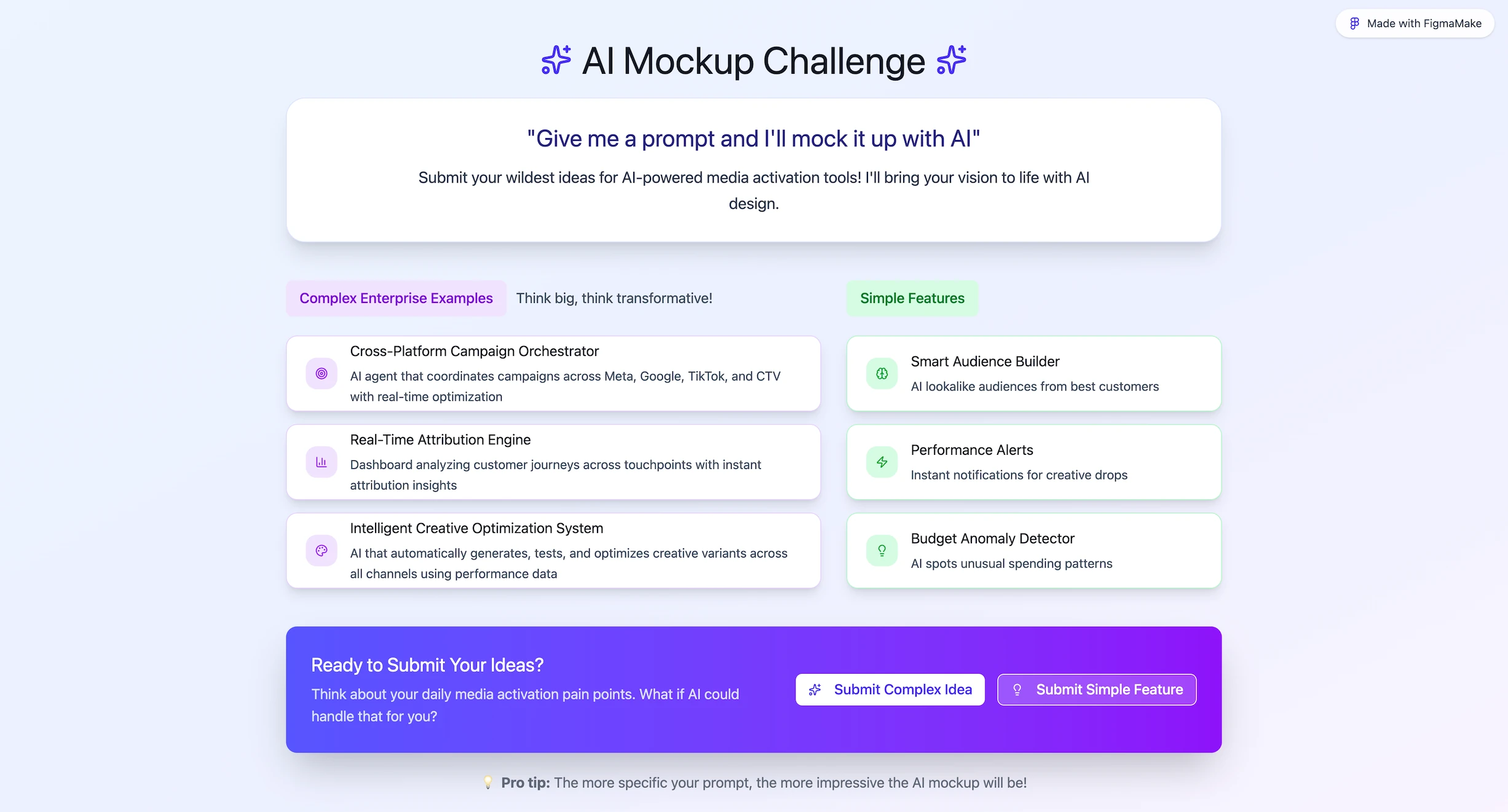
In September 2025, a workshop brought together 25 people from across the domain to discuss the direction: one activation experience, with a seamless user experience. I facilitated design activities to introduce AI-assisted design, then newly emerging, to the cross-discipline group and got them to prompt and prototype ideas that solved a range of product problems.
It was fun and engaging, and the first time many of our product leaders had experimented with making things themselves. The group produced 12 prototypes across a range of problems.
Taking the initiative
Stepping into the gap: shaping the product vision
The business recognised the need for a unified experience, but one fundamental challenge remained: how could we bring disconnected products and workflows together into a coherent user experience?
No individual product team owned the end-to-end experience. I saw an opportunity to bring a broader design perspective, connect the pieces and shape a solution that worked across product boundaries.
I put my hand up.
In an organisation where design was typically brought in once requirements and solution approaches were already taking shape, I saw the opportunity to contribute much earlier: helping frame the problem, explore possible futures and influence what we should build.
In October 2025, I created the first Activation Hub concept: a conversation starter on how disconnected products could become part of a coherent experience. It gave stakeholders something tangible to react to and helped move conversations away from individual product roadmaps towards a shared end-to-end vision.
The first draft proposal received a very clear, positive reaction from senior stakeholders, who wanted to sponsor the initiative.
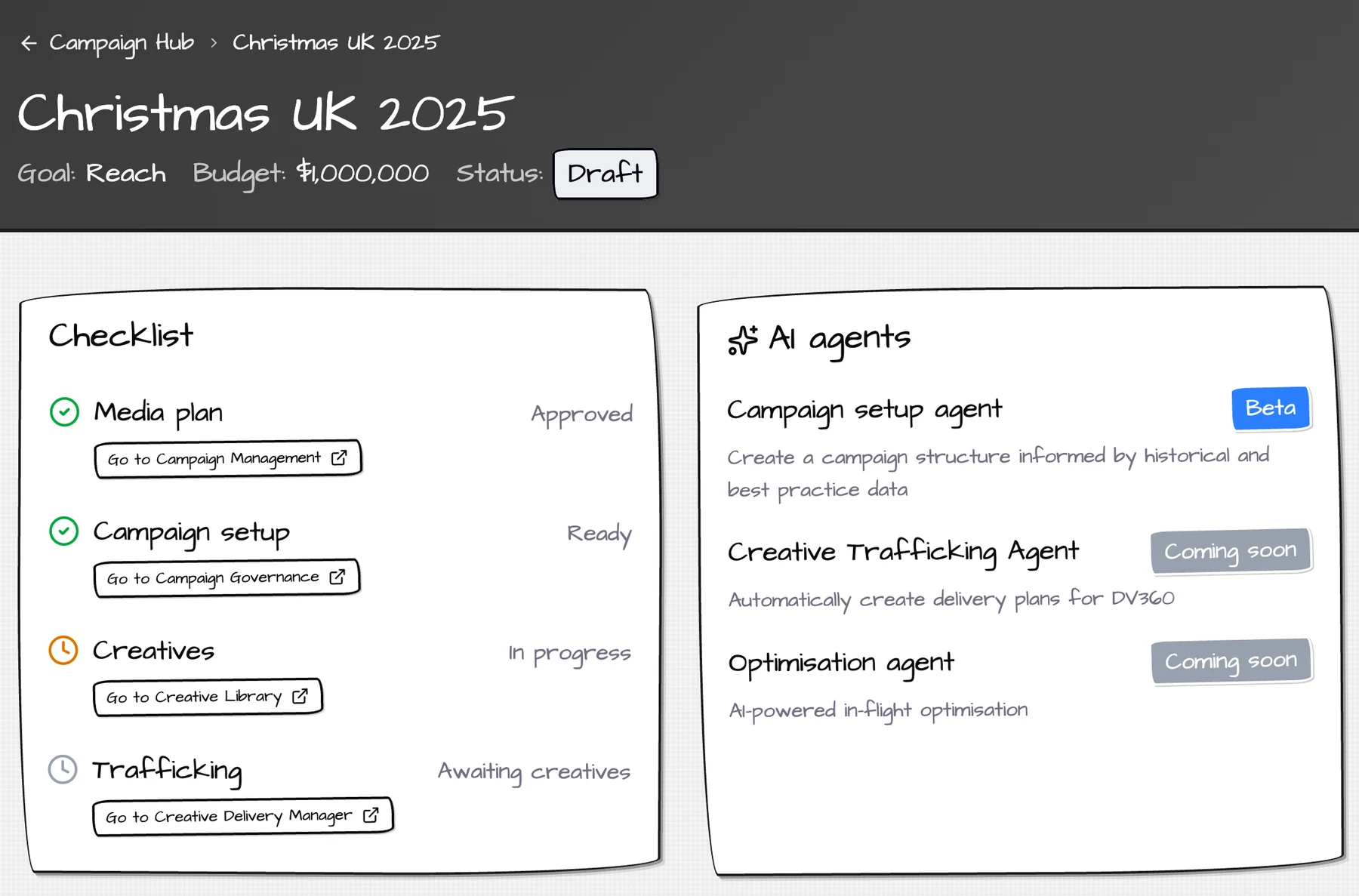
We formed a small, focused, cross-functional discovery group to explore what a unified solution could look like.
Over the following months, I combined domain research, stakeholder discussions and rapid prototyping to explore different directions. I walked key stakeholders through the concept in focused sessions, including product managers responsible for the individual products. The prototype helped surface assumptions, expose disagreements and create alignment around a shared direction.
The business gave the green light to build the product.
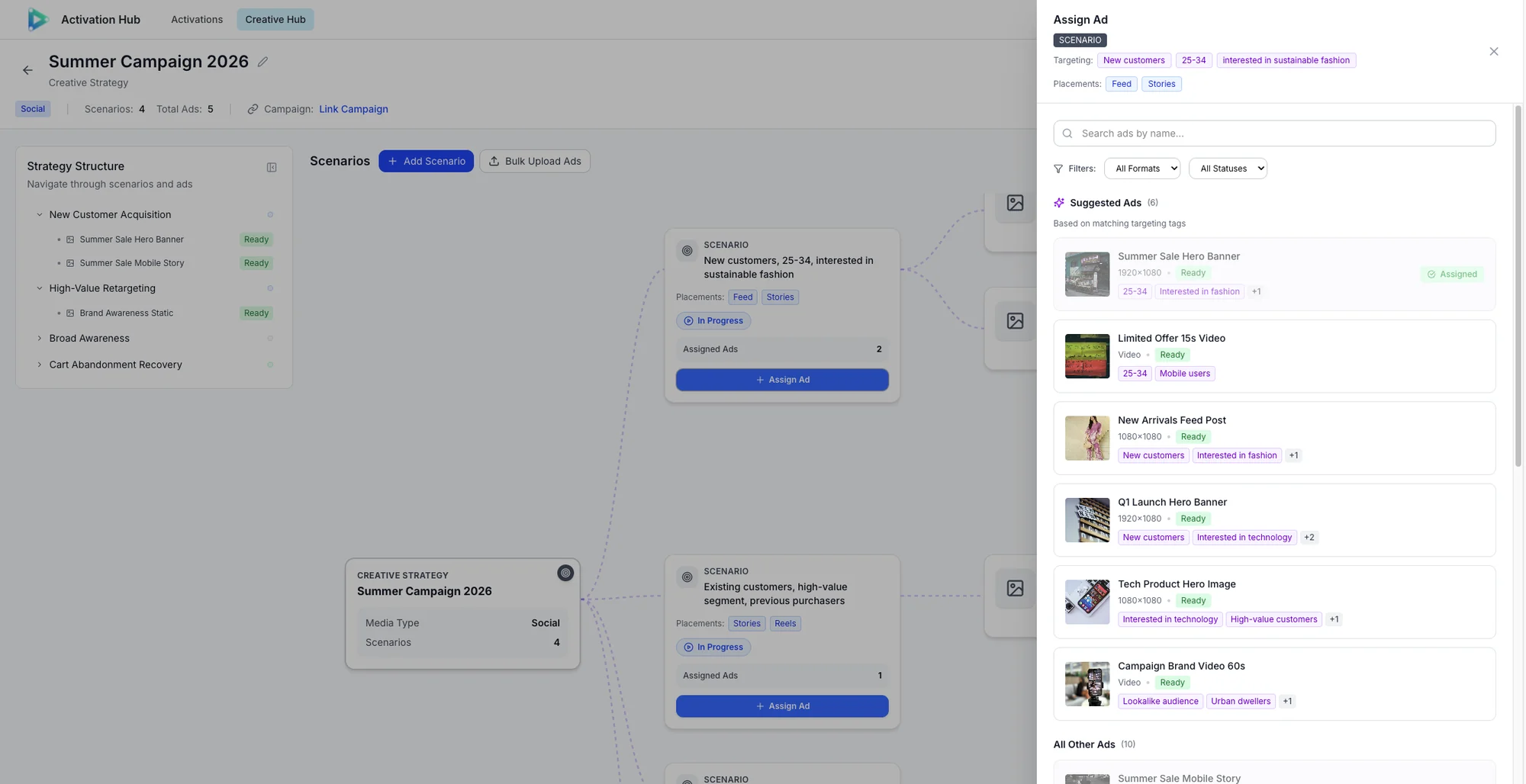
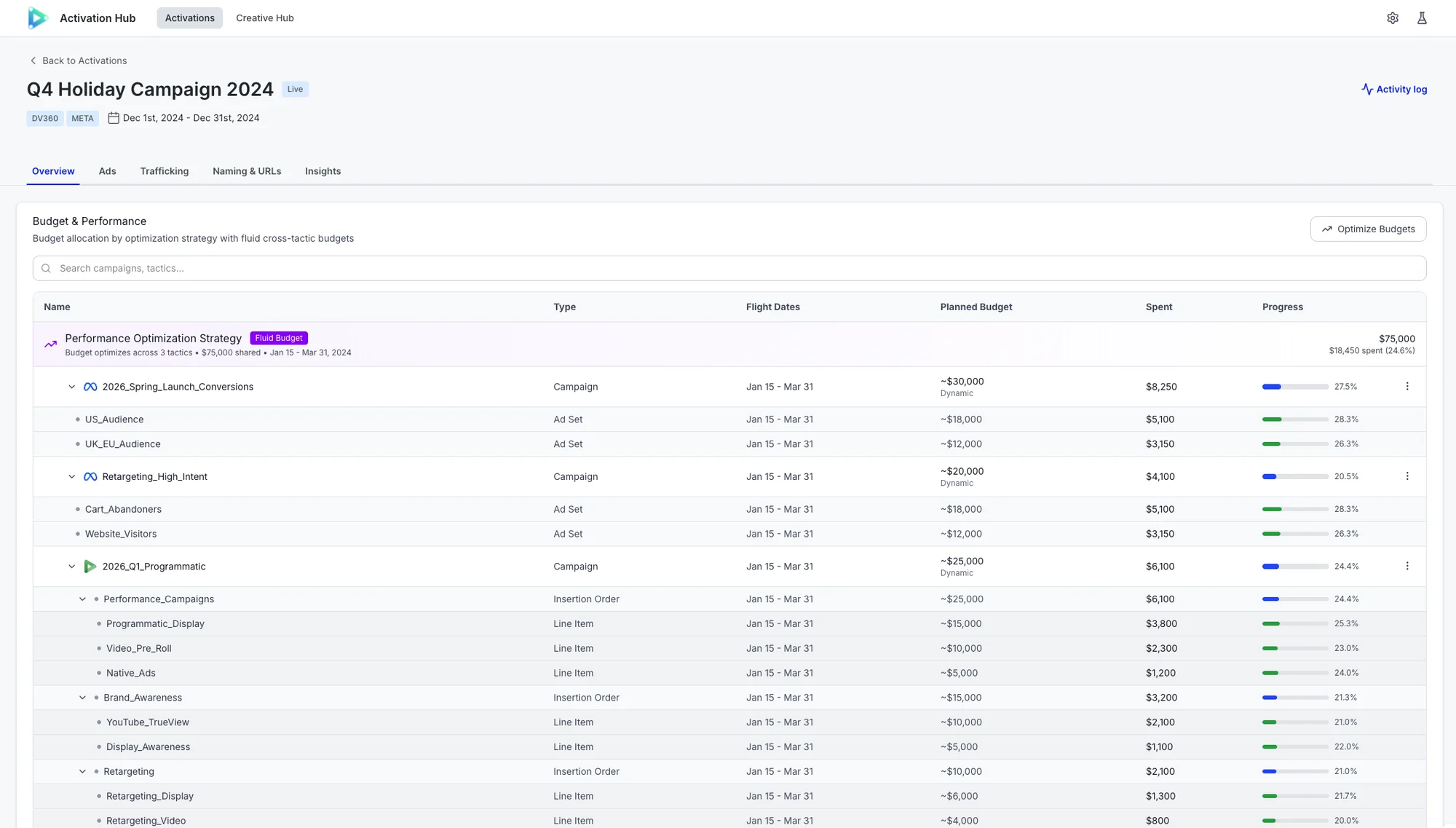
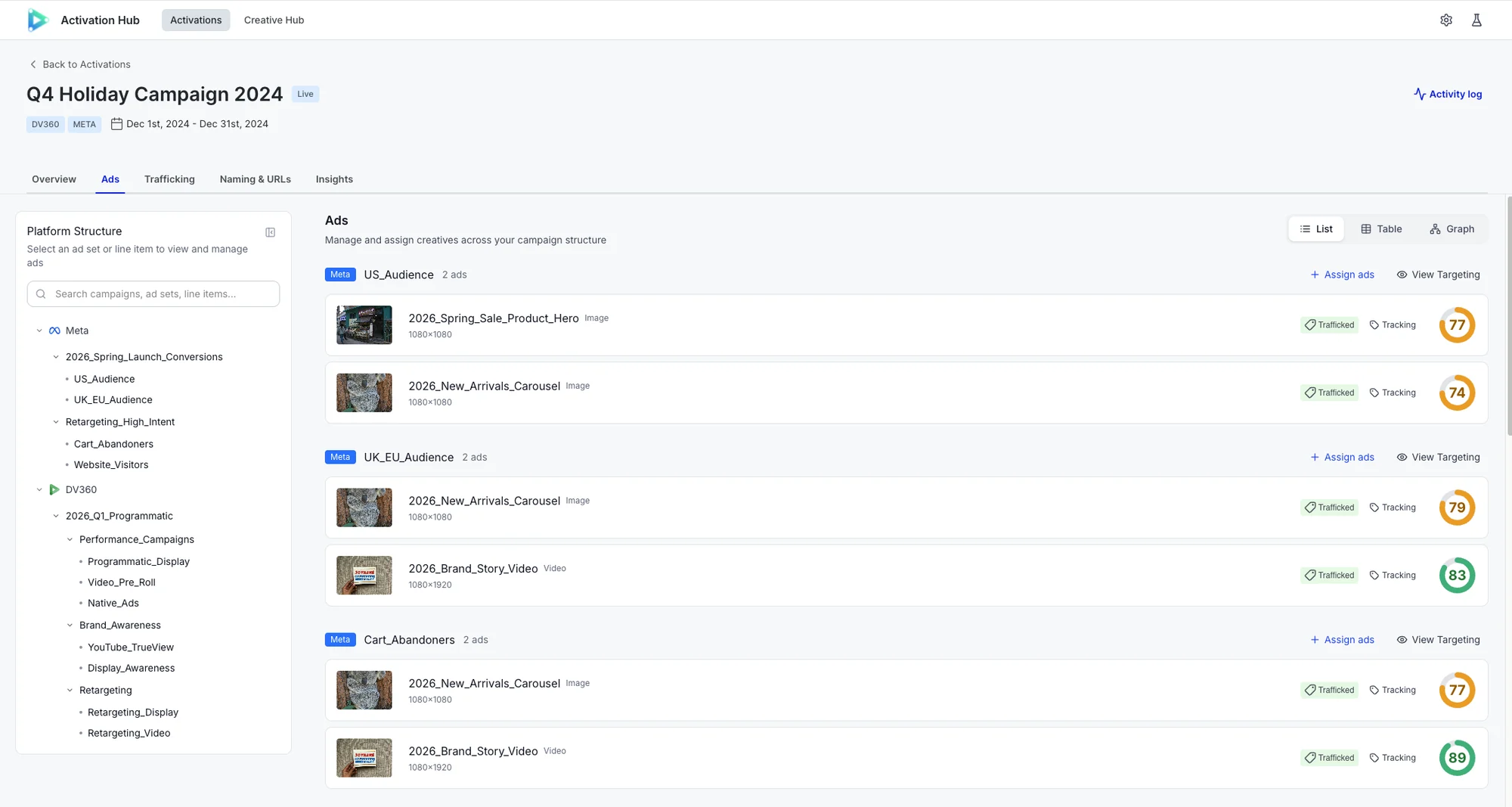
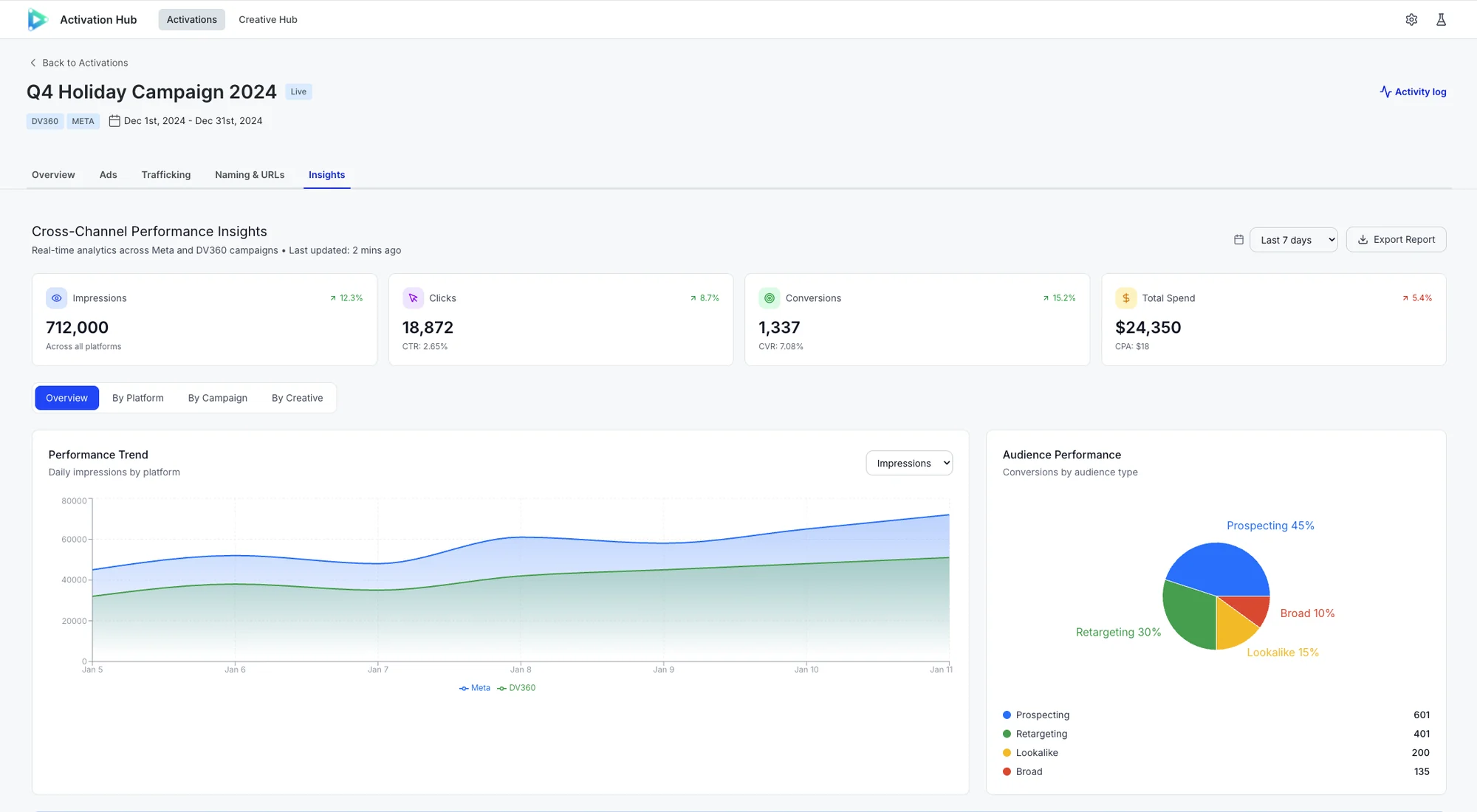
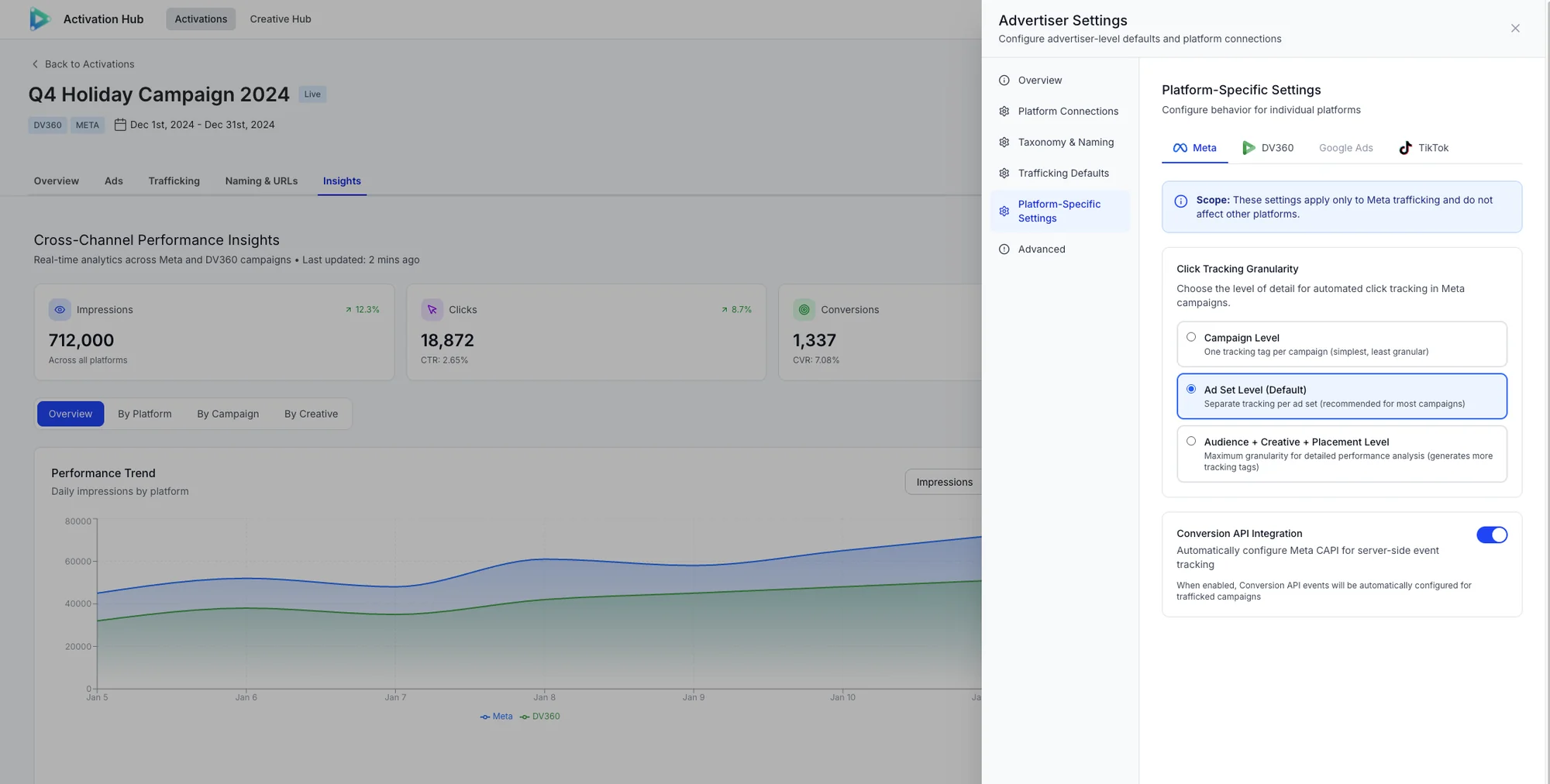
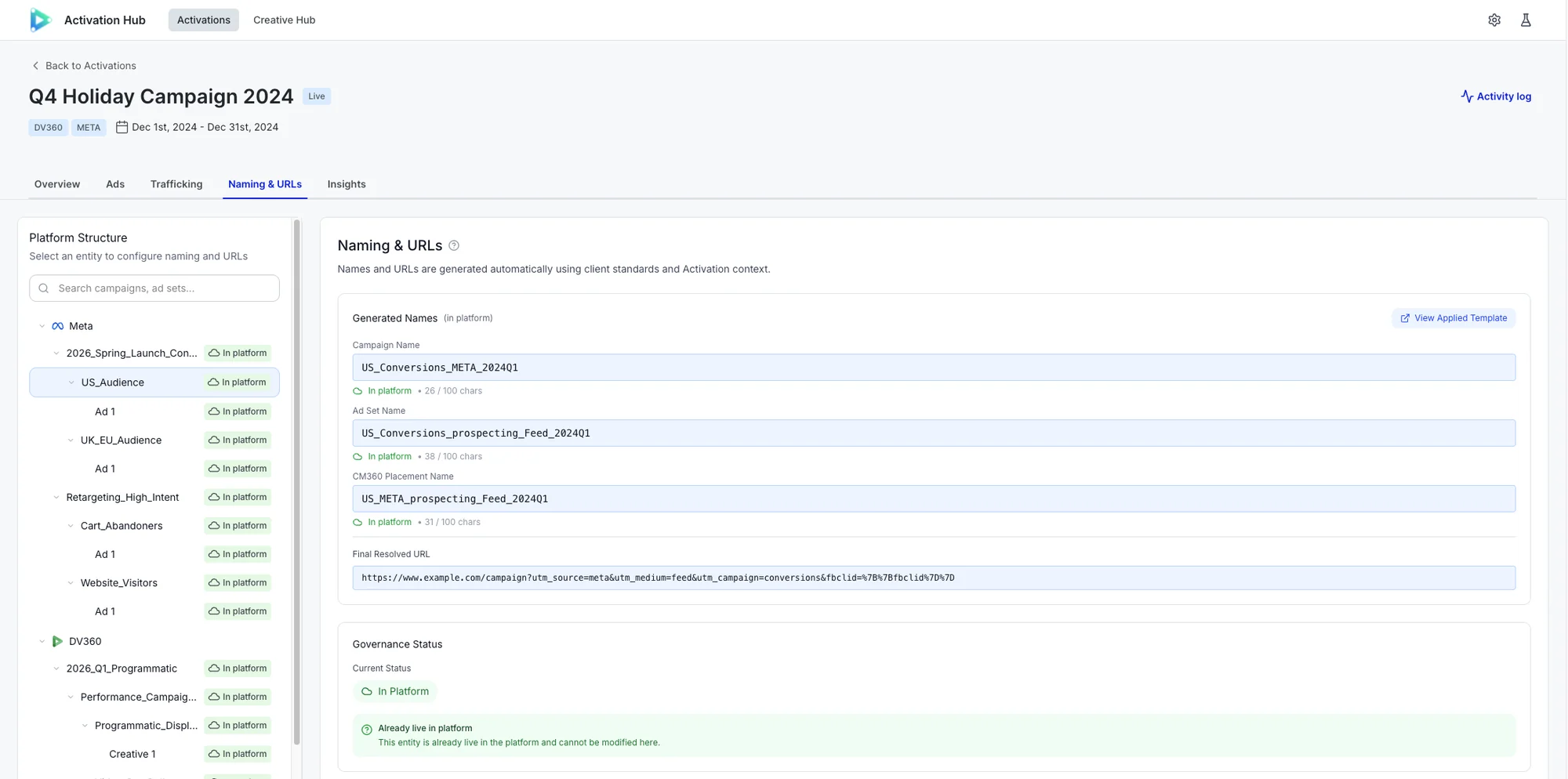
Early wireframes exploring how the capabilities could come together. They are not the final designs.
The prototype became a tool for shaping product strategy, aligning teams and turning a broad business ambition into a tangible direction for delivery.
Designing with AI
Behind that prototype was a steep learning curve. This is how I went from a blank page to a direction the business could back.
Activation spans buying platforms and ad servers, each with its own hierarchy, constraints and terminology. The problem was so broad and complex that the team had not been able to tackle it. Three weeks of focused research and ideation gave me roughly 80% of the foundational approach to build on, depth that normally takes months of learning from specialists.
- 01
Learn the domain
Deep dives into media activation and ad operations: buying platforms (DV360, Google Ads, Meta, TikTok), ad servers (CM360, SA360), their constraints, specifications, terminology and hierarchies.
GeminiChatGPTClaudeUnlockedDomain depth in weeks, not months
- 02
Normalise the variations
Drafted the hierarchies and flows from the research, pushing for normalisation across platforms so a single flow could work for all of them.
LLMsUnlockedOne flow for every platform
- 03
Explore in parallel
LLMs drafted detailed prompts. Different prompts and tools produced alternatives to compare against the goal. One direction won, and I kept building on it.
Figma MakeLovableUnlockedThe right direction, chosen with evidence
- 04
Prototype in code
When Figma Make could not handle the interaction complexity, I exported its code to Claude Code and carried on there.
Claude CodeUnlockedEngineers react to a working prototype
Validated throughout. The LLM research was the foundation, and I built on it through feedback loops with practitioners (users) and product experts.
The working prototypes became the way to iterate on feedback and to explain the solution to engineers, without the full cycle of Jira tickets, Figma mockups and annotations. I also use Claude Code to ship small content and cosmetic fixes, opening merge requests for engineers to review.
From vision to product
Turning the vision into a deliverable experience
Once the initiative moved into delivery, the challenge shifted from demonstrating a compelling future state to making a complex, cross-team workflow work in practice.
One Media Activation Team, One Shared Mission
I started by investigating how creative activation worked in practice, interviewing practitioners and examining their workflows, tools and workarounds. The research revealed a clear opportunity: simplifying ad operations handovers between creative and activation teams.
Preparing campaigns involved spreadsheets, emails, tickets and coordination across multiple teams, often taking days and creating opportunities for costly errors. Existing tools were built to support a wide range of advanced use cases, making them powerful but complex to configure. Meanwhile, teams had already established best practices for managing these workflows — but those practices weren’t reflected in the tools.
With business priorities likely to evolve, I wanted to focus on a gap between our existing capabilities and what practitioners needed most. Streamlining creative activation offered immediate, tangible value while laying a foundation that would remain useful even if the broader product vision changed.
I used research, prototypes and feedback to make the opportunity tangible and align teams around the end-to-end user journey. Where product managers disagreed on foundational decisions, I brought the discussion back to shared user needs and business outcomes rather than the requirements of individual products.
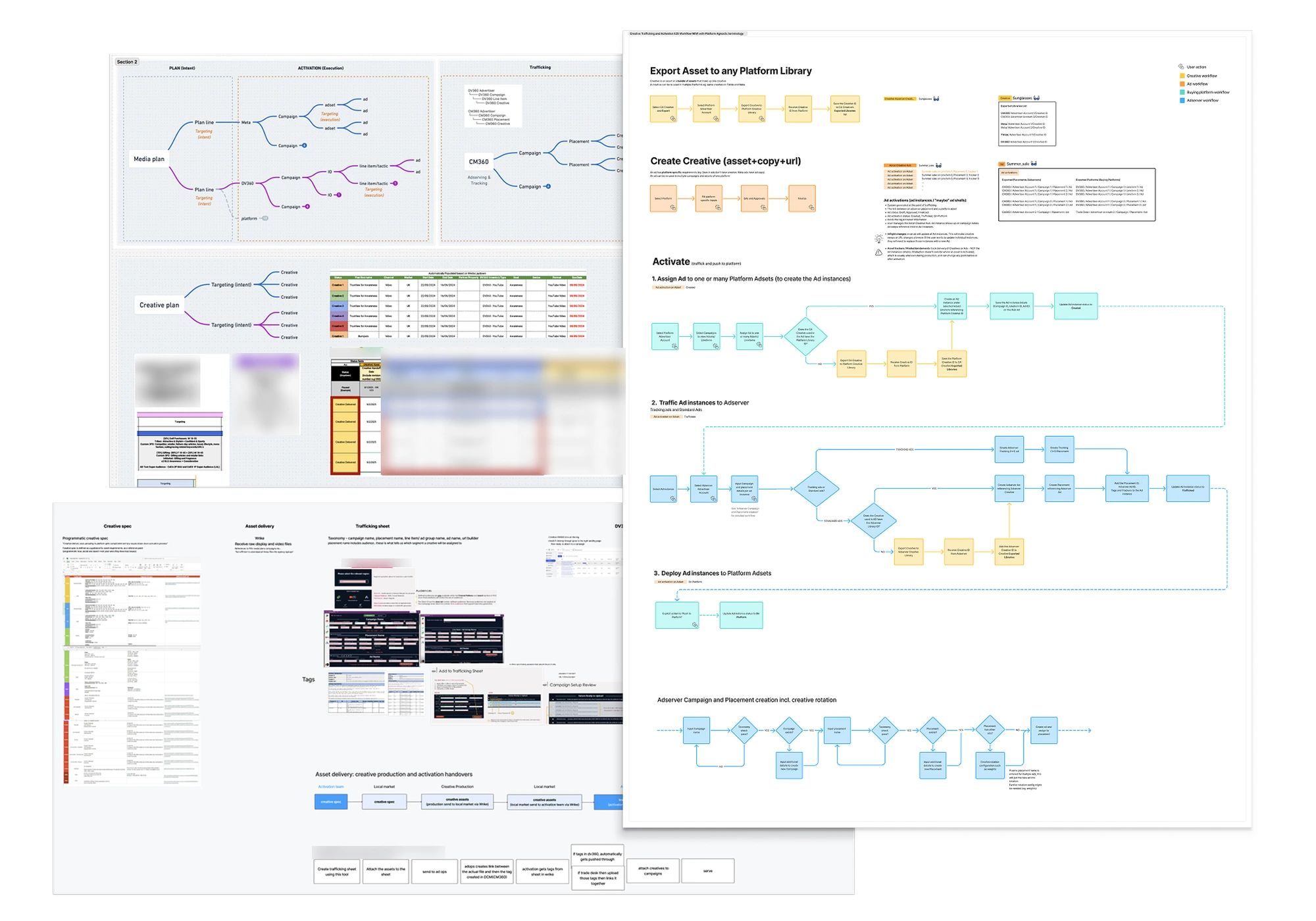
Four connected workstreams, one coherent experience
I translated the broader platform vision into a focused set of capabilities, combining hands-on design with design leadership across multiple workstreams.
Closing a high-value gap
Creative trafficking & activation
- Led research, prototyping and detailed design through to delivery
- Connected ad-server trafficking and platform activation in one guided workflow
- Fewer manual handovers and fewer errors
Shaping the agentic experience
Agentic campaign setup
- Explored how AI turns a media plan into a platform-ready campaign structure
- Prototyped with Claude Code to set the interaction model and UX direction
- Managed designers to deliver the final mockups
Experience design oversight
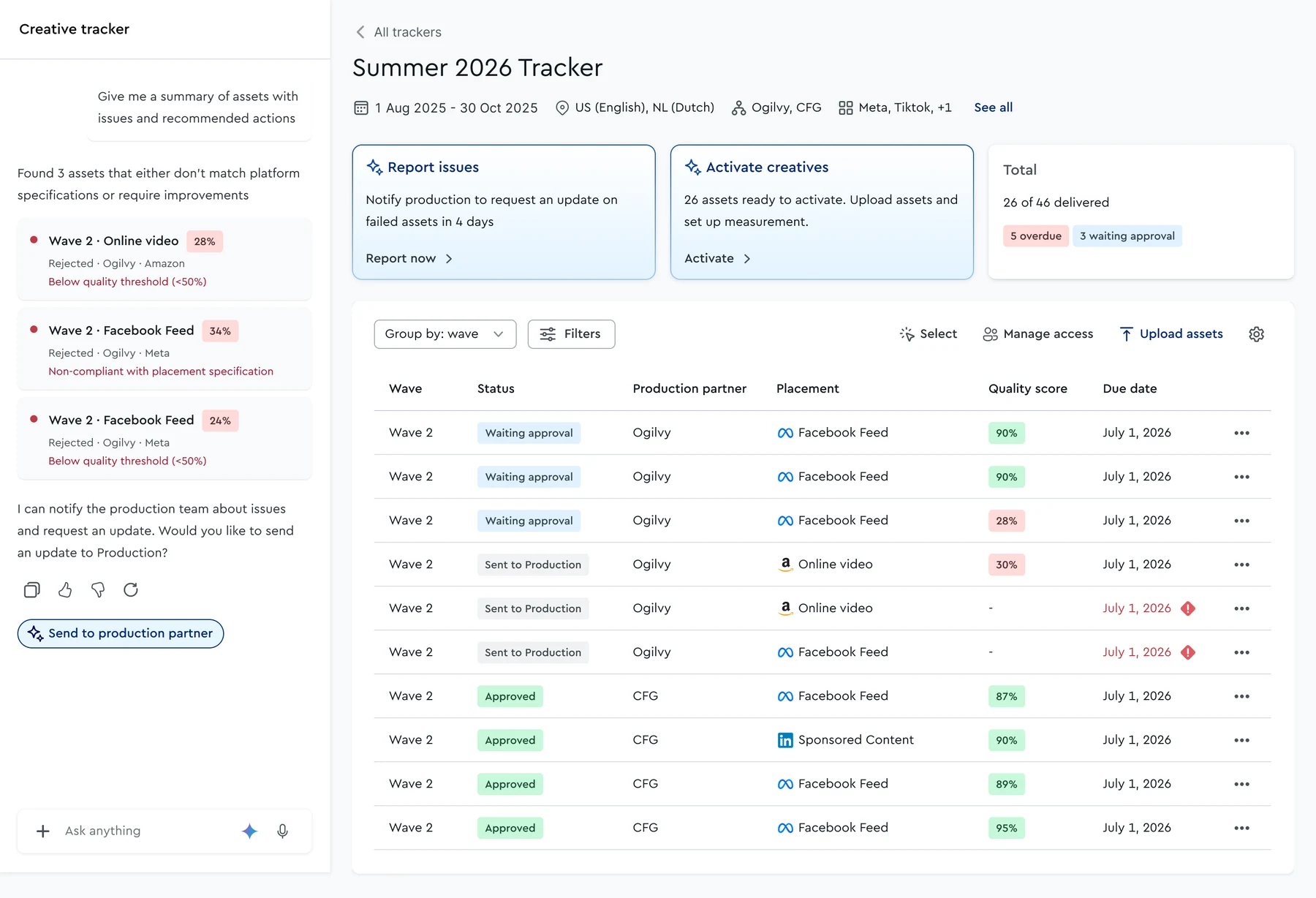
Creative tracker
- Brought the wider product context into decisions
- Prevented duplicated or overlapping functionality
- Aligned product managers with competing approaches
Integrating an existing capability
Campaign monitoring
- Design oversight of the existing monitoring capability
- Guided the changes needed to fit the new end-to-end workflow
- Kept its value while making it feel like part of one experience
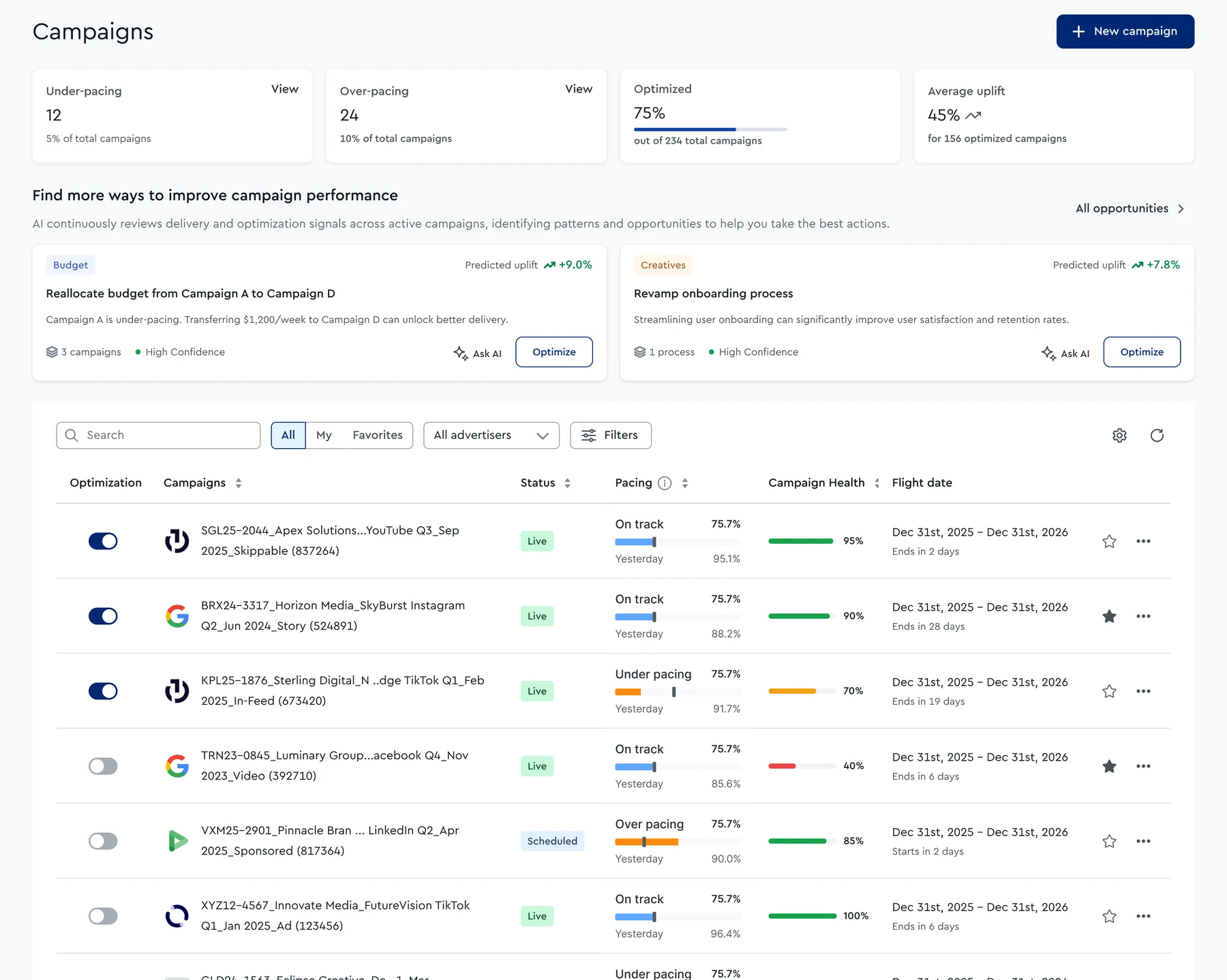
Agentic campaign setup
Translating user intent into reliable action
Campaign setup involves turning media plans and objectives into detailed, platform-specific configurations. It’s repetitive, data-intensive work spread across systems, where mistakes can be costly.
The core design challenge is turning ambiguous intent and variable data into reliable, platform-ready inputs. This means building in media best practices, validation and guardrails, while keeping users in control to review and correct configurations before taking action.
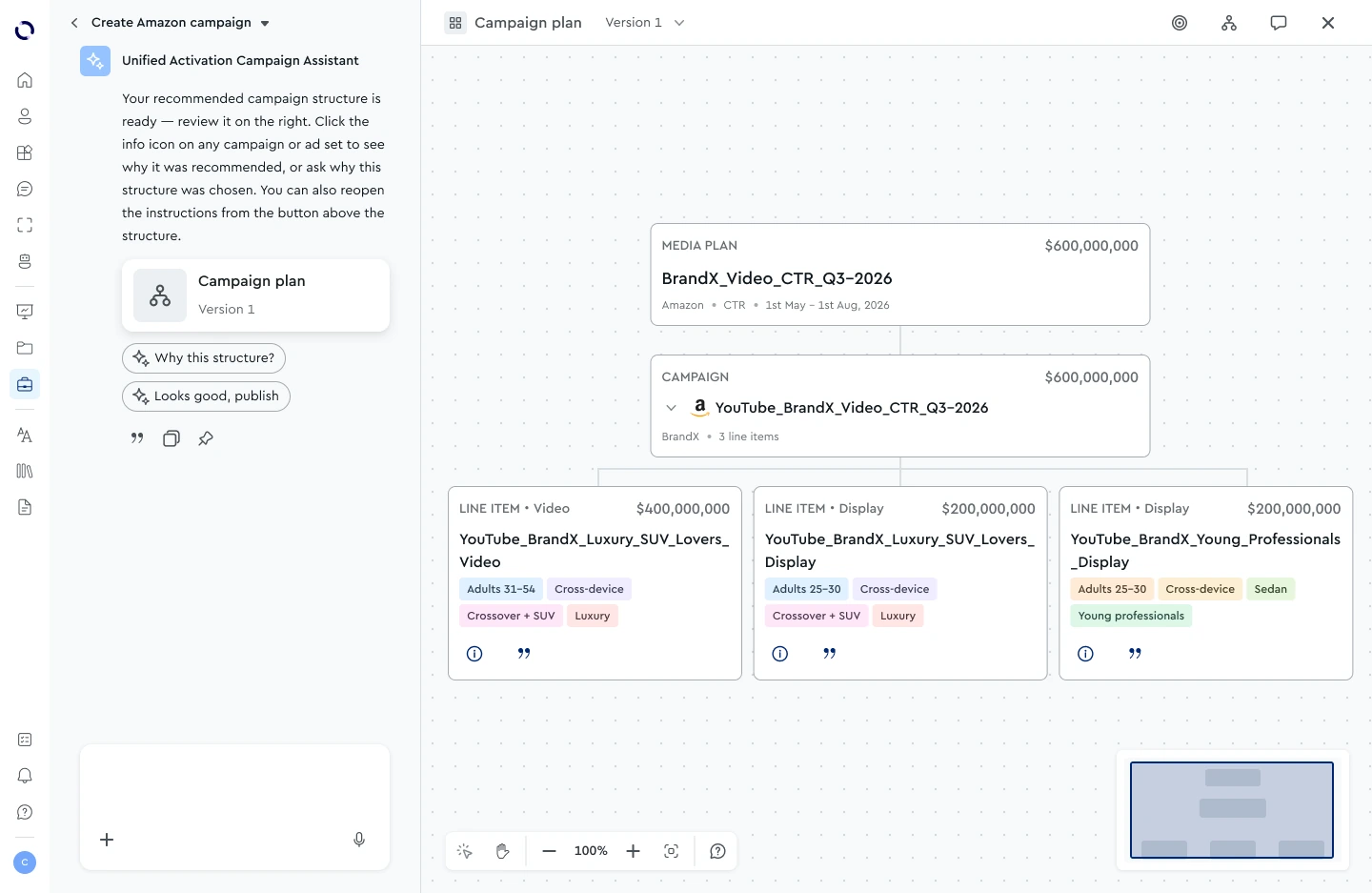
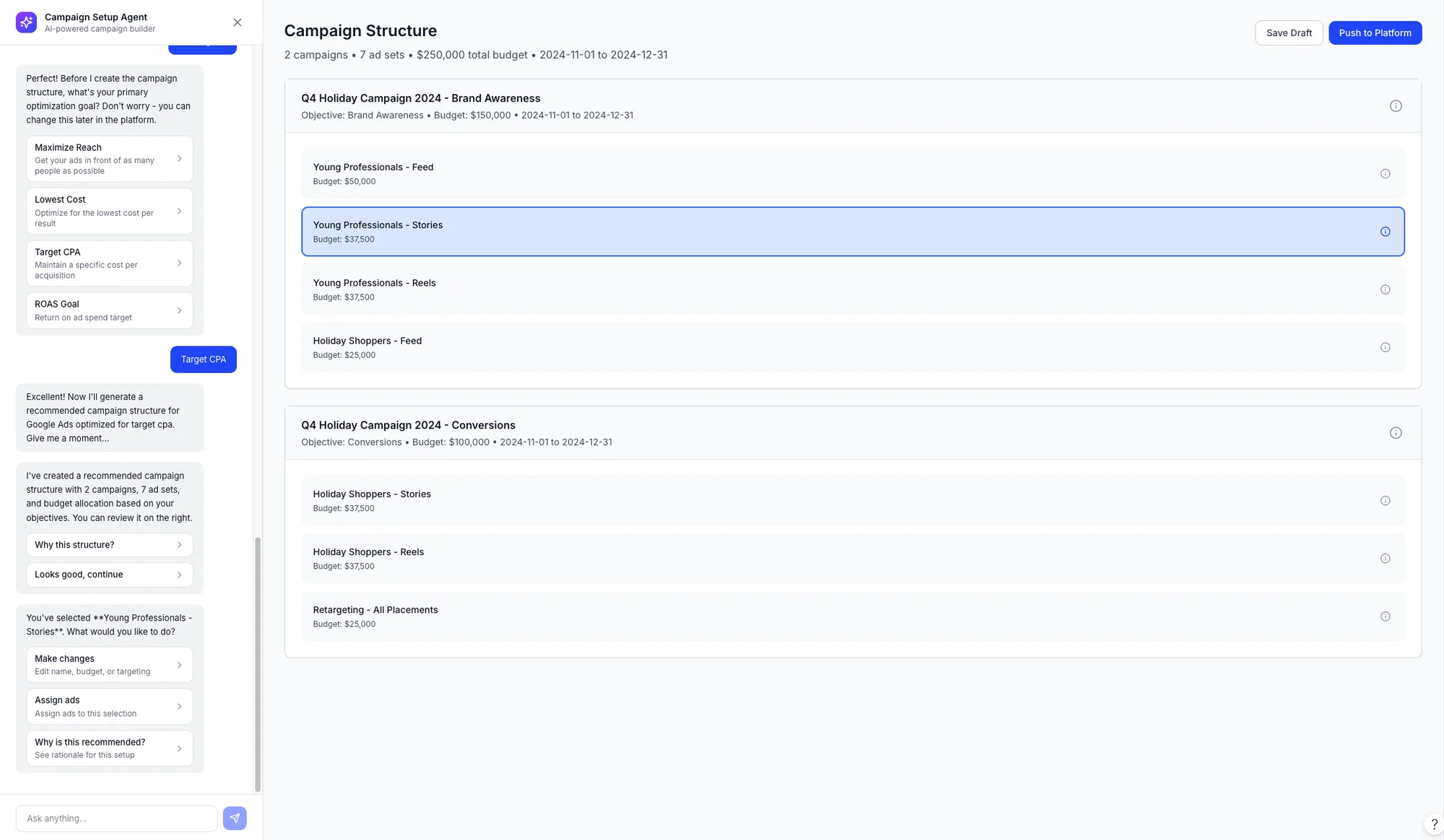
I established the initial design direction through prototypes exploring how AI could interpret natural-language requests or media plans, identify missing information and propose campaign structures. Working together with Data Science, Engineering and designers, we are taking the direction into detailed UX exploration, researching user needs and refining the final mockups for tier-one clients.
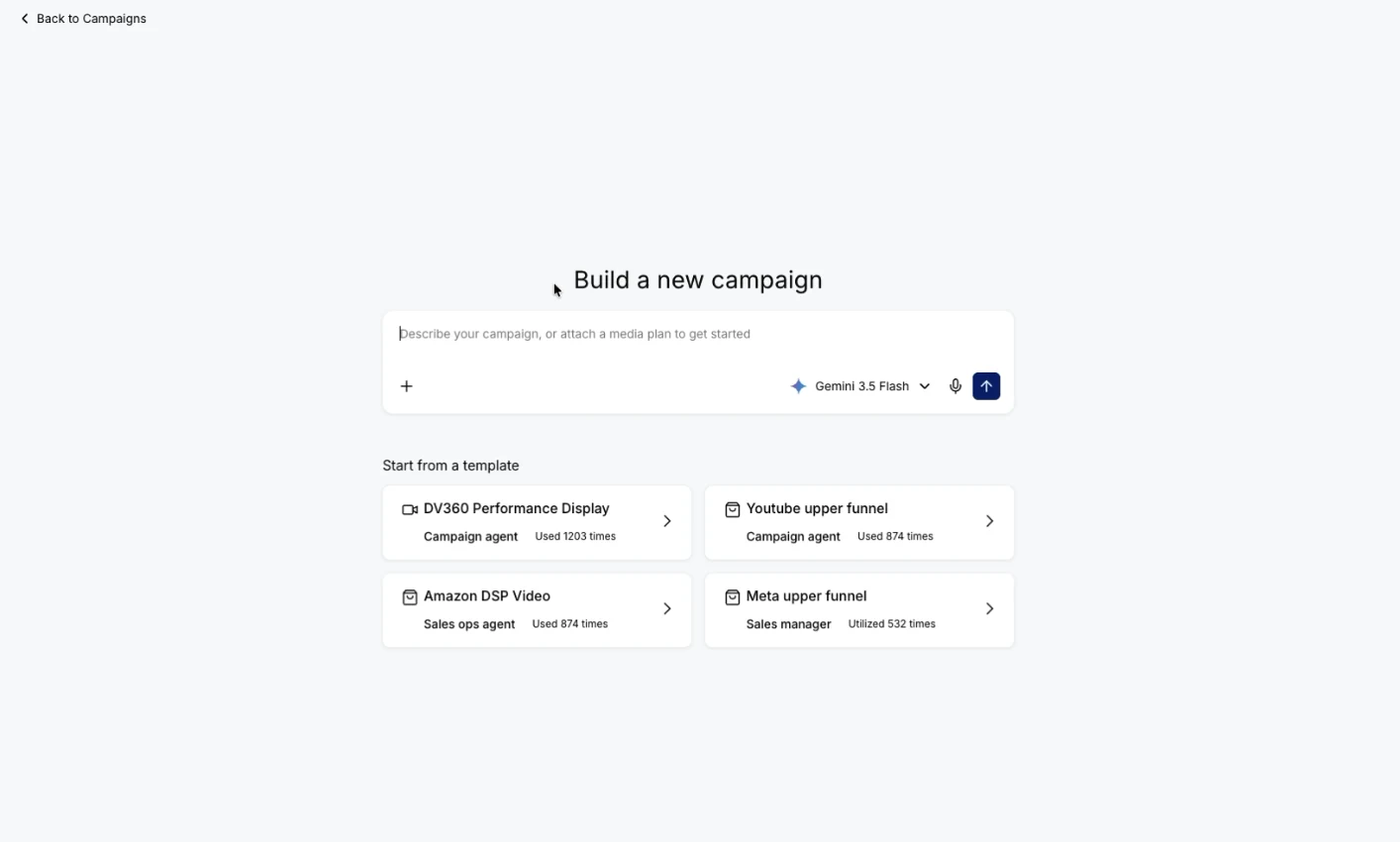
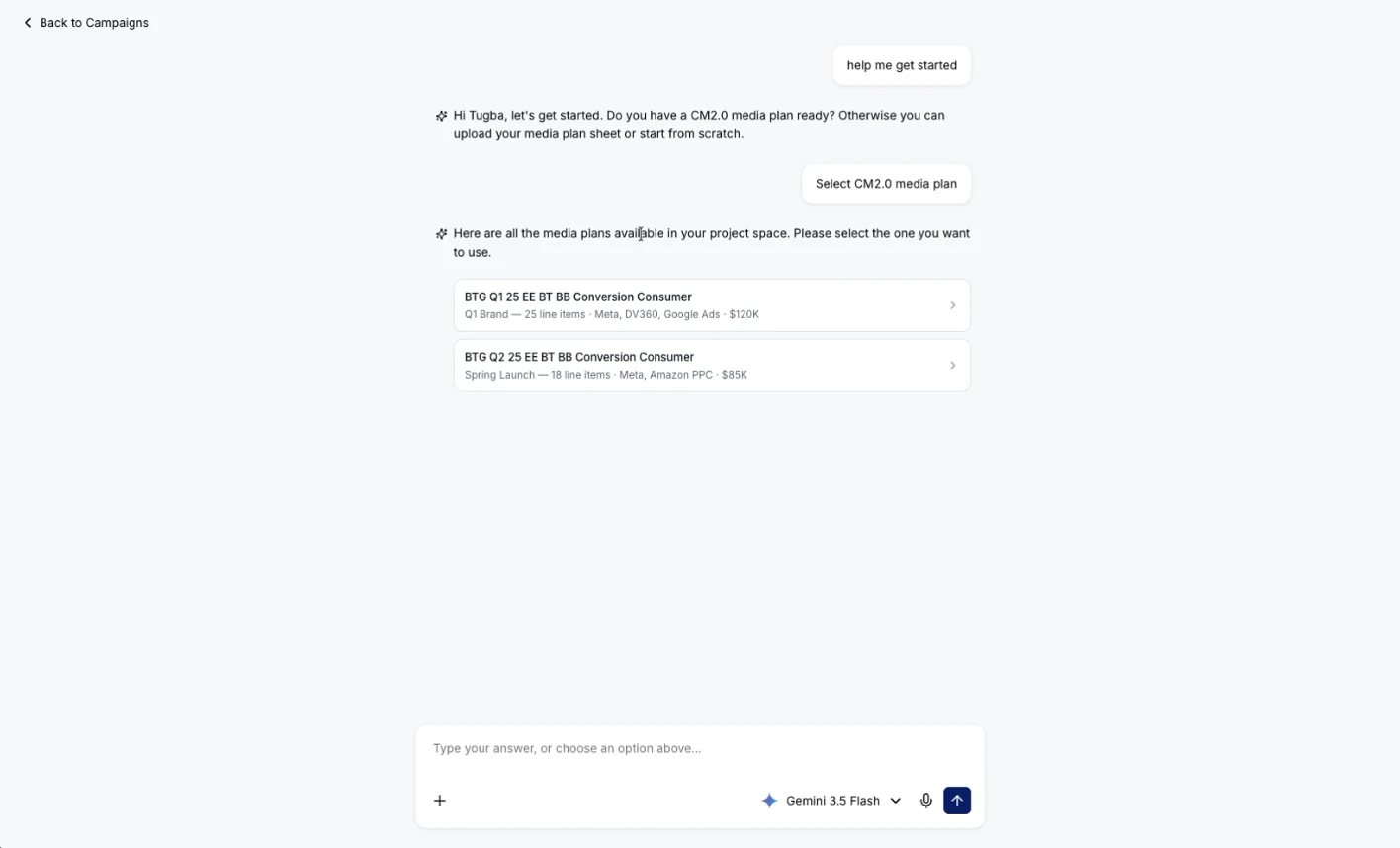
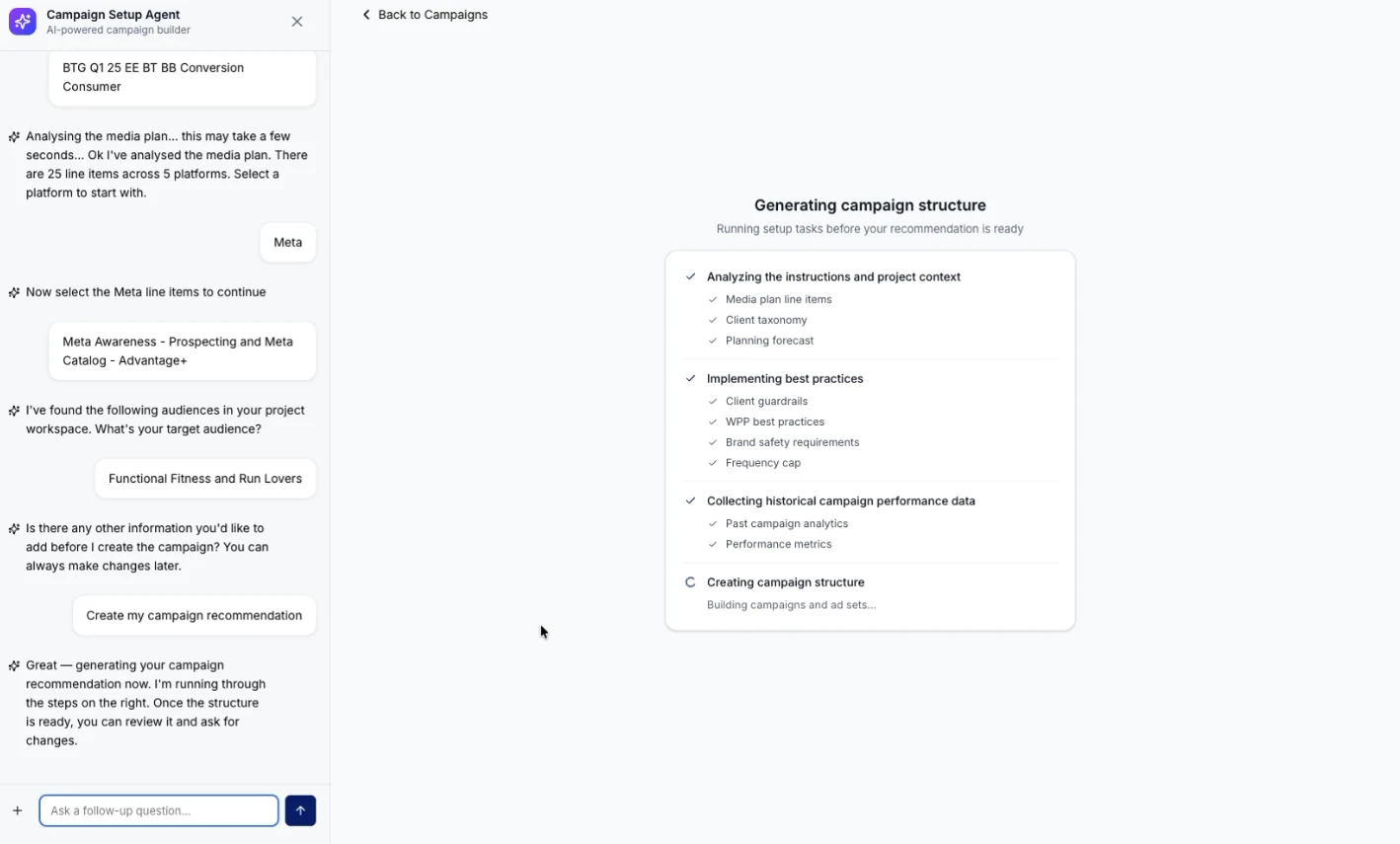
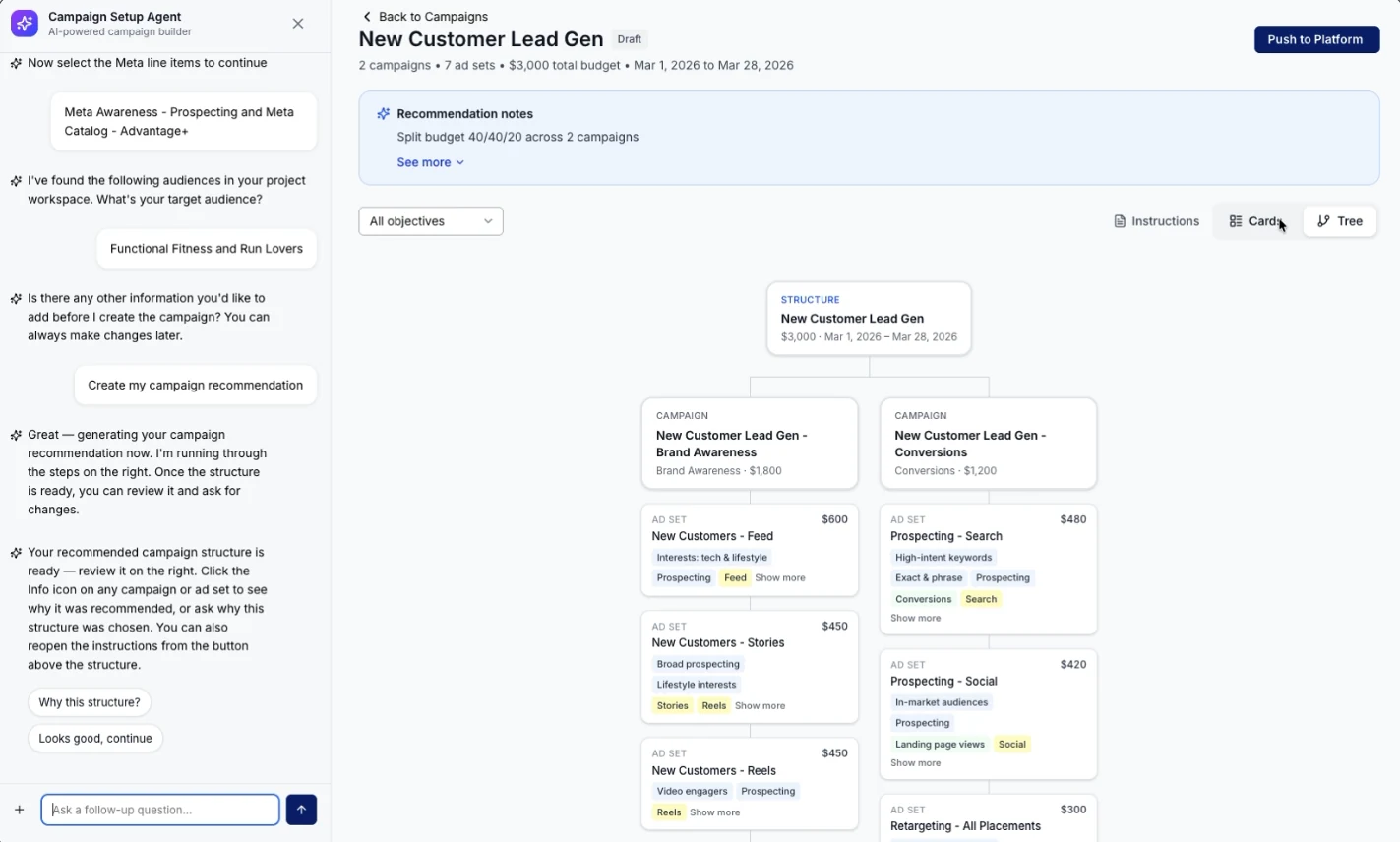
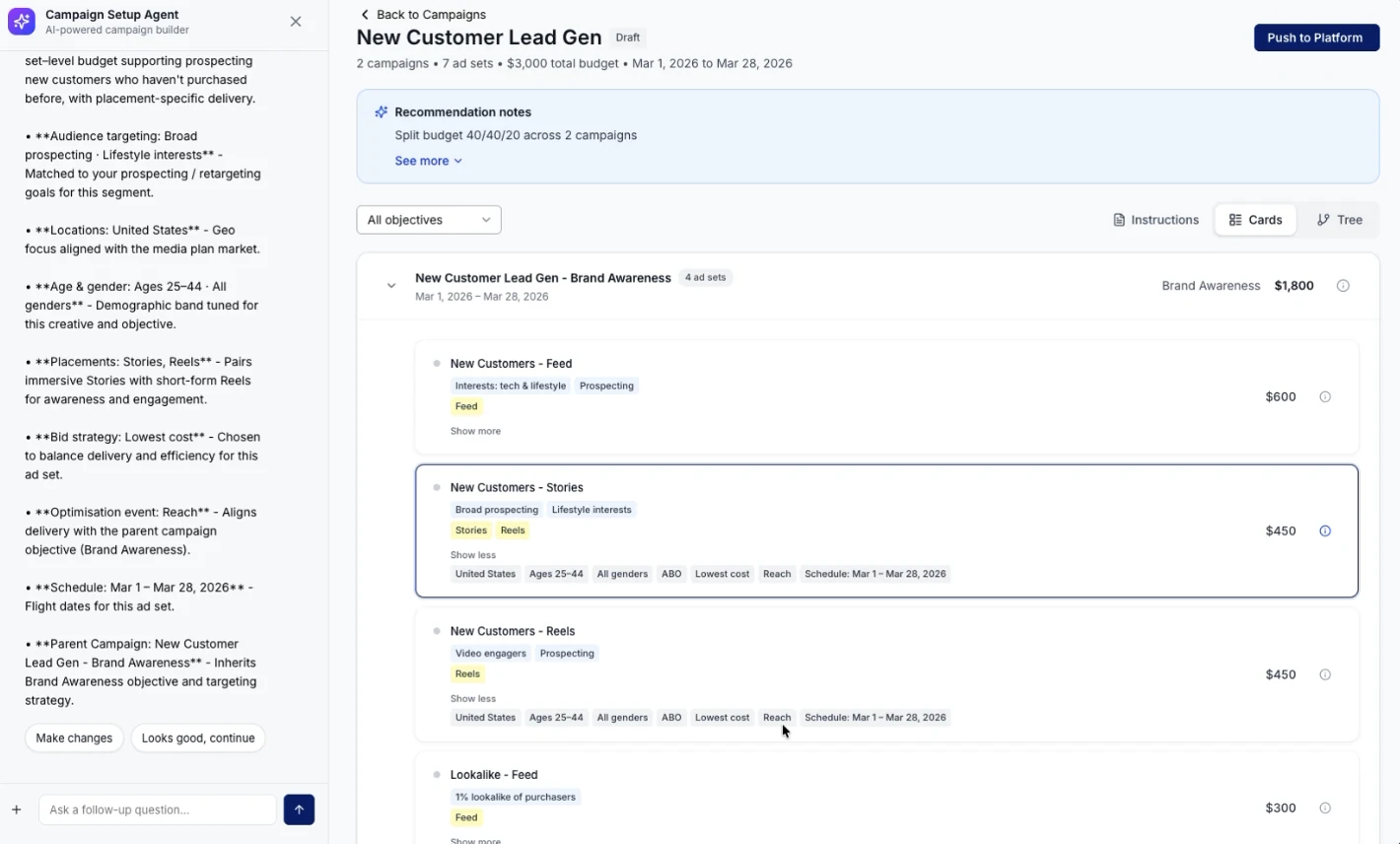
Early prototype screens exploring the experience. They are not the final designs.
The aim is to make campaign setup simpler, helping AI turn user intent into reliable campaign configurations while keeping the right checks, best practices and human oversight in place.
Outcome and reflections
From a concept to Activation Hub
An early version of Activation Hub has launched as a pilot, with some capabilities still in continuous development.
What we started to build is future-facing, scalable and high value, and it will keep growing. We laid the foundations of the agentic experience and streamlined media activation.
Built to scale
- More agents
- More platforms
- More integrations
Agentic experience
Intent turned into reliable action, with people in control.
Streamlined media activation
Connected journeys across trafficking and activation.
Beyond bringing capabilities together, the project created a shared product direction across previously siloed teams. Design now shapes the problem early, instead of delivering UI against an already-defined backlog.
The most valuable design leadership often happens before a project has a name, an owner or a place on the roadmap.
I look beyond individual products to the wider system, recognise problems before they become requirements, and use research and making to help people see possibilities they couldn’t yet articulate. I work where user needs, business strategy and technical complexity meet, and take ownership when a problem falls between teams.
Contact
I’m always interested in connecting with people building thoughtful products, tackling complex challenges and putting design at the heart of meaningful change.